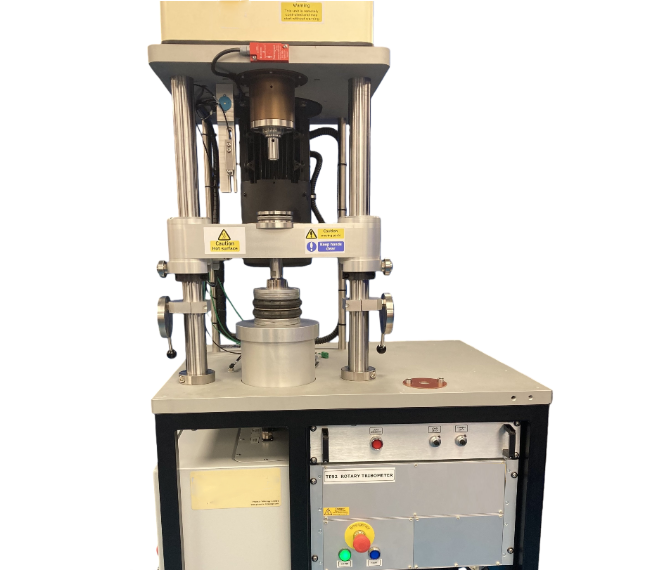
The Rotary Tribometer is a multifunctional friction and wear testing instrument designed for compreh
WhatsApp : +86 15601902607
Email : info@qinsun-lab.com

The Rotary Tribometer is a multifunctional friction and wear testing instrument designed for comprehensive tribological research. You use this system to study friction behavior, wear mechanisms, and lubrication performance under controlled rotational motion. By combining axial loading, precise load control, and an open test platform, the Rotary Tribometer allows you to simulate a wide range of real operating conditions, including dry friction, lubricated friction, high-speed rotation, and high-temperature environments. It provides accurate measurement of friction coefficient, wear behavior, temperature, vibration, and electrical contact resistance for material and lubricant evaluation.
You can apply the Rotary Tribometer in laboratory research, quality evaluation, and component performance testing across multiple industries, including:
Lubricant anti-wear, extreme-pressure, and friction performance evaluation
(four-ball tests, thrust washer tests)
Material friction and wear research
(pin-on-disk, thrust pad, bearing materials, rolling contact fatigue)
Performance evaluation of hydraulic and lubrication system components
(pump vanes, slipper pads, seals)
Friction, wear, and lifetime analysis of bearings, gears, and rotating components
High-temperature dry friction and lubricated friction testing
(with test temperatures up to 600 °C using high-temperature fixtures)
Tribocorrosion and electrochemical wear studies
(lip seals and three-electrode systems)
Small-sample friction testing
(LVFA, Suzuki-type tests, miniature thrust pads)
Rolling contact fatigue and tilting bearing performance evaluation
You can conduct tests in accordance with widely recognized international and regional standards, including:
(1) GB/T 3140 series – Wear performance testing of lubricating oils and greases
(2) ASTM D2266 – Anti-wear properties of lubricating grease (four-ball method)
(3) ASTM D2783 – Extreme pressure properties of lubricating fluids
(4) ASTM D3702 – Thrust washer wear testing
(5) ASTM D4172 – Anti-wear properties of lubricating oils
(6) ASTM D5183 – Determination of friction coefficient of lubricants
(7) ASTM G99 – Pin-on-disk wear testing
(8) DIN 50324 – Determination of friction and wear of solid materials
(9) DIN 51350 (Parts 1–6) – Lubricant shear stability and wear testing
(10) ISO 11008 – Extreme pressure properties of lubricating greases (four-ball method)
(11) IP 239 / IP 300 – Lubricant extreme pressure and wear tests
(12) CEC L-45-T-93 – Shear stability of transmission fluids
| Item | Standard Configuration | High-Speed Configuration | Upgraded Configuration |
|---|---|---|---|
| Speed Range | 30–3,000 rpm | 30–3,000 rpm / 100–10,000 rpm | Same as high-speed |
| Maximum Spindle Load | 10,000 N @ 3,000 rpm | 10,000 N @ 3,000 rpm / 4,000 N @ 10,000 rpm | Same as high-speed |
| Maximum Spindle Speed | 6,000 rpm | 10,000 rpm | 10,000 rpm |
| Torque Capacity | 14 Nm @ 30–1,500 rpm | 14 Nm @ 30–1,500 rpm / 7 Nm @ 3,000 rpm / 2.1 Nm @ 10,000 rpm | 25 Nm @ 30–1,500 rpm / 13 Nm @ 3,000 rpm / 4 Nm @ 10,000 rpm |
| Motor Power | 2.2 kW, single-phase | 2.2 kW, single-phase | 4 kW, three-phase |
| Temperature Capability | Up to 600 °C (with high-temperature fixture) | Up to 600 °C (with high-temperature fixture) | Up to 600 °C (with high-temperature fixture) |
| Load Range | 1–10,000 N (depending on actuator) | 1–10,000 N (depending on actuator) | 1–10,000 N (depending on actuator) |
| Control Parameters | Speed, load, temperature, test time | Speed, load, temperature, test time | Speed, load, temperature, test time |
| Recorded Parameters | Speed, friction torque, friction coefficient, contact resistance, temperature, sliding distance, cycle count | Same as standard | Same as standard |
| Data Interface | USB / software | USB / software | USB / software |
| Air Supply | ≥ 4 cfm @ 8 bar | ≥ 4 cfm @ 8 bar | ≥ 4 cfm @ 8 bar |
| Dimensions | 900 × 600 × 2,000 mm | 900 × 600 × 2,000 mm | 900 × 600 × 2,000 mm |
| Weight | 350 kg | 350 kg | 350 kg |
Multi-condition testing capability supporting dry friction, lubricated friction, rolling contact, thrust pad, and four-ball configurations
Wide load range from low-load precision testing to high-load extreme pressure evaluation
High-speed spindle design with precision bearings ensuring stable operation up to 10,000 rpm
Online monitoring of temperature and vibration with automatic shutdown protection
Electrical contact resistance measurement for tribocorrosion and wear-corrosion interaction studies
Flexible fixture compatibility for pin-on-disk, thrust pad, four-ball, pump vane, and rolling fatigue tests
Digital data acquisition with automatic recording and export in standard data formats
High-temperature testing capability up to 600 °C for dry and lubricated friction research
(1) Low-load actuator (20–1,000 N)
(2) High-load actuator (200–10,000 N)
(3) Precision low-load fixtures for small-sample testing
(4) Four-ball sliding and rolling test fixtures
(5) Pin-on-disk and block-on-ring adapters
(6) Specialized fixtures for rolling fatigue and seal testing
(7) Lubricant circulation system
(8) Calibration system for load, torque, and temperature
(9) Electrochemical testing unit for tribocorrosion experiments
(1) Verify that power supply, air supply, and lubrication systems are properly connected.
(2) Install the appropriate test fixture and actuator according to the selected test method.
(3) Secure the specimens carefully to ensure uniform contact.
(4) Set test parameters including load, speed, temperature, and test duration.
(5) Start the test and monitor friction torque, temperature, vibration, and other parameters in real time.
(6) Allow automatic safety protection to stop the test if abnormal vibration or overload occurs.
(7) After completion, remove specimens and record wear results for analysis.
You should regularly clean test fixtures and remove wear debris after each test to avoid cross-contamination. Load, torque, and temperature sensors should be calibrated periodically to maintain measurement accuracy. Bearings and moving components should be inspected according to usage frequency. When operating at high temperature or high speed, you should ensure adequate cooling and follow recommended maintenance intervals to extend equipment service life.
The Rotary Tribometer provides you with a highly flexible and reliable platform for friction, wear, and lubrication research. Its wide load range, high-speed capability, high-temperature testing, and multi-parameter measurement make it suitable for both fundamental tribology studies and applied component performance evaluation in industrial and research environments.
(1) What is this product?
This product is a rotary friction and wear testing instrument used to study tribological behavior under controlled rotational motion. It allows you to evaluate friction, wear, lubrication performance, and surface interactions using standardized and customized test methods.
(2) What is this product used for?
You use this instrument to test lubricants, materials, and mechanical components. Typical uses include anti-wear and extreme-pressure testing of lubricants, wear behavior analysis of materials, and durability evaluation of bearings, gears, seals, and rotating parts.
(3) What is the working principle of this product?
The working principle is based on controlled contact between test specimens under axial or radial load while one component rotates. Friction torque, temperature, vibration, and electrical contact resistance are measured in real time to characterize friction and wear behavior under defined conditions.
(4) Why is this product important?
This product is important because it helps you understand how materials and lubricants behave under real operating conditions. The test results support material selection, lubricant formulation, product design optimization, and failure analysis, reducing development risk and improving reliability.
(5) What industries is this product suitable for?
This product is suitable for lubricant manufacturing, automotive engineering, aerospace, mechanical engineering, materials science, energy, and research institutions that require accurate friction and wear evaluation.
Qinsun Instruments Co., LTD is a professional laboratory testing instrument manufacturer in China,Have been focusing on laboratory instrument R&D more than 30 years and have rich industry experience,Based on international testing standards,We are also the instrument supplier for BV SGS laboratory,We provide one-stop solutions for lab instruments,Free Training and Turn-Key Service,Products exported all over the world,Offer 36 month warranty and are a trustworthy partner.

Company Phone
+86-21-6420 0566
Working hours
Monday to Friday
Mobile phone:
13816217984
Email:
info@qinsun-lab.com