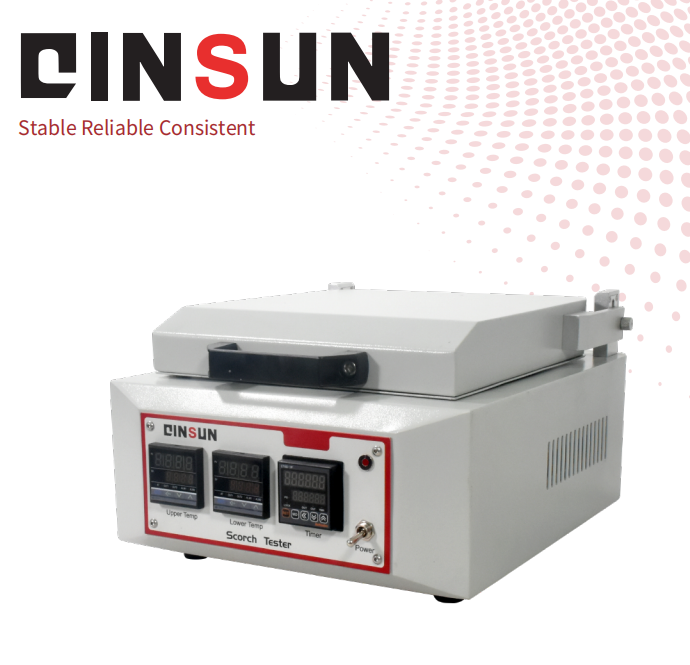
Precision Scorch & Sublimation Fastness Tester for Textiles.
WhatsApp : +86 15601902607
Email : info@qinsun-lab.com

G247B Color fastness tester for ironing sublimation, It is used for the performance test of color fastness to hot pressing resistance ironing and pressing and dry heat (sublimation) of various dyed printing textile materials and textiles. It can also be used to determine the sublimation of color fastness test for chlorine resistance, scorching, yellowing test of bleaching products, and disperse dyes of textiles, as well as water fastness test of reactive dyes, dimensional stability at high tem perature, etc.Besides,it is commonly used in textile and garment fields such as printing and dyeing fabrics, textile auxiliaries, etc., which can effectively control production and test product performance.
G247B Color fastness tester for ironing sublimation, It is widely used for the hot pressing resistance ironing and pressing of various dyed printing textile materials, dry heat (sublimation) test, textile chlorine resistance, scorching, yellowing test of bleaching products, and water fastness test of reactive dyes, as well as dimensional stability at high temperature.
It is applicable to the performance verification of new products, quality control of the production department, and the of material properties for the third-party testing organization, the product performance verification laboratory, and the quality and technical supervisiondepartment, etc.
GB/T 5718 Textile color fastness test
P01 part: color fastness to dry heat (except hot pressing)
GB/T 6152 Textiles, color fastness test, Colour fastness to hot pressing
JIS L0879 Test method of dyeing color fastness to dry heat
JIS L0850 Colour fastness to hot pressing.
ISO 105 P01 Textiles - Tests for colour fastness - Part P01: colour fastness to dry heat (including heat treatment)
ISO 105 X11 Textiles - Tests for colour fastness - Part X11: Colour fastness to hot pressing
AATCC 117 Colour fastness to dry heat (no pressure)
AATCC 133 Colour fastness to high temperature (hot pressing)
M&S C13 Colour fastness to high temperature (hot pressing)
M&S C10 Dimensional stability test
Upper and lower heating module independent temperature control
The upper and lower inde pendent temperature control system adopts PID temperature control program, with features of high temperature control precision, low heating overload efficiency, and equipped with PT 100 temperature sensor.
Floating pressurized design
The floating design is carried out when the load is pressurized, allowing the testing of materials of different thicknesses. The pressure distribution and uniform heating can still be ensured in case of testing thicker materials.
Independent temperature control system
The timer is configured to preset the test time. It is automatically start the test timing once the upper platen is pressed downwards, and the buzzer is configured to prompt the test end.
Unique appearance design
The appearance of the tester is exquisite and beautiful. The insulation around the upper and lower heating plates is designed with insulation material to ensure that the heat of the heating plate is not transmitted to the outer casing, which is safe and reliable.
Test hot plate:W100 X D40mm (same of the upper and lower) | Tem perature control: independent control of the upper and lower |
Heating plate metallurgy: high purity aluminum | Warming-up time: user-defined |
Timer: preset time, automatic timing once the upper plate pressing downwards. | Applicable test: hot pressing, dry heat, dimensional stability |
Heating range: ambient temperature -300°℃ | Time alarming: buzzing alarm |
Hot panel pressure:4±1 KPa(40cm2) | Weight 25kg |
Power:220V 1.6Kwindependent control of the upper and lower | Power supply: 220V 50Hz |
Appearance size:400mmX400mmX450mm |
1. Pre-operation Preparation
First, adjust the working environment to meet JIS L0803 standard conditions: temperature 20±2℃ and relative humidity 65±3%. Acclimatize both the instrument and test samples in this environment for at least 4 hours. Then, cut textile samples into 150mm×50mm pieces (one piece per workstation), ensuring no wrinkles or defects. Finally, check the instrument: confirm it’s connected to the correct power supply (e.g., AC 220V/50Hz) and inspect rubbing heads and workstations for intactness.
2. Parameter Setting
Turn on the "Power" button on the control panel. Set test parameters according to relevant JIS standards (e.g., JIS L0849 or JIS K6328): adjust the pressure to 4.9N (the standard value for JIS tests), set the reciprocating speed to 30 cycles/min, and input the required rubbing cycles (e.g., 20 cycles for JIS K6328). Verify all parameters on the digital display to ensure accuracy.
3. Loading Samples & Crocking Cloth
For each workstation, fix the prepared sample flat on the test stage (use clamps to avoid displacement during testing). Attach a JIS L0805 standard white crocking cloth (50mm×50mm) to the bottom of each rubbing head, and secure it tightly with the clamping ring to prevent slipping during friction.
Initiate the TestAfter confirming all samples and components are properly installed, press the "Start" button to begin the test. Monitor the instrument’s operation throughout; if abnormalities occur (e.g., sample shifting, unusual noise), press the "Emergency Stop" button immediately. The instrument will stop automatically once it completes the preset rubbing cycles.
4. Post-test Handling
Press the "Stop" button, then carefully remove the crocking cloths and tested samples. Evaluate the results using the JIS L0805 grey scale: grade both the staining of the crocking cloth and the discoloration of the sample (on a scale of 1 to 5. where 5 indicates the best fastness). Record all test details (sample information, set parameters, and evaluated grades) in a test log for future reference.
5. Instrument Cleaning & Storage
Turn off the power and disconnect the instrument from the power supply. Wipe the sample stage, rubbing heads, and control panel with a dry, clean cloth to remove debris. Store unused standard crocking cloths in a dry, sealed container, and keep the instrument in a dust-free, dry environment when not in use.
Qinsun Instruments Co., LTD is a professional laboratory testing instrument manufacturer in China,Have been focusing on laboratory instrument R&D more than 30 years and have rich industry experience,Based on international testing standards,We are also the instrument supplier for BV SGS laboratory,We provide one-stop solutions for lab instruments,Free Training and Turn-Key Service,Products exported all over the world,Offer 36 month warranty and are a trustworthy partner.

Company Phone
+86-21-6420 0566
Working hours
Monday to Friday
Mobile phone:
13816217984
Email:
info@qinsun-lab.com