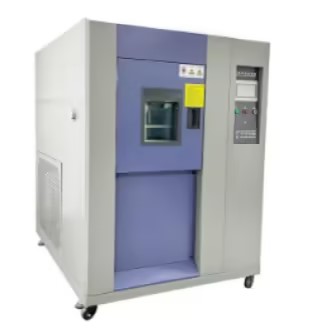
The thermal - cold cycle testing machine is a testing device used to test the heat resistance, cold
WhatsApp : +86 15601902607
Email : info@qinsun-lab.com

The Thermal-Cold Cycle Testing Machine is a professional equipment used for high and low-temperature reliability testing. It is primarily used in fields such as electronics, electrical engineering, automotive, and aerospace, to test the performance of materials and components under extreme temperature conditions. It conforms to GB/T2423.1.2.3 standards and supports three test modes: high temperature, low temperature, and thermal shock. Rapid temperature switching can be achieved through a two-chamber or three-chamber structure.
1. Electronics and Electrical Engineering: Testing the temperature stability of chips, batteries, etc., to meet industry standards;
2. Automotive Industry: Verifying the temperature resistance of automotive electronics and body materials;
3. Materials Science: Screening the temperature tolerance of plastics and composite materials to support material selection;
4. Aerospace/Defense Industry: Adapting to extreme temperature change scenarios to ensure stable equipment operation;
5. Medical/Construction Materials: Verifying the temperature durability of medical equipment and building materials to meet compliance requirements.
BS 7291: Compliant for thermal cycling tests on thermoplastic pipe systems (1769 Series with pressure chamber).
Adaptive Certification: Configurable to meet ISO, ASTM, and EN standards upon request.
(1)Dual Models for Diverse Needs:
1769 Series (Pressurized): Operates up to 114°C with integrated pressure chamber for BS 7291 compliance.
1770 Series (Non-Pressurized): Cost-efficient solution for tests up to 95°C.
(2)Smart Sample Management:
Adjustable tension rig with load cell (0–500N) for real-time strain monitoring.
Perforated wall panels and custom fixtures for irregularly shaped specimens.
(3)Safety & Efficiency:
Dual-access doors (single/double-hinged) for ergonomic loading.
Self-cleaning water circuit minimizes maintenance downtime.
(4)Connected Workflow:
IoT-ready controller with 7-day auto-sequencing and cloud data backup.
Multi-language HMI (English, French, German, Chinese) with audit trail logging.
| Specification | 1769 Series (Pressurized) | 1770 Series (Non-Pressurized) |
|---|---|---|
| Temperature Range | -20°C to 114°C | -20°C to 95°C |
| Max. Test Pressure | 16 bar (232 psi) | N/A |
| Flow Rate | 25 m³/h (108 GPM) | 25 m³/h (108 GPM) |
| Max. Sample Ø | 160 mm | 160 mm |
| Power Supply | 380V/50Hz 3-phase (CE certified) | 220V/60Hz single-phase (UL listed) |
| Chamber Volume | 850L (expandable to 1.200L) | 600L |
| Dimensions (W×D×H) | 1.200mm × 800mm × 1.900mm | 900mm × 700mm × 1.700mm |
| Weight | 680 kg (net) | 520 kg (net) |
1.Chamber Access:
Single-hinged door (standard) or dual-swing doors for walk-in loading.
2.Sample Fixation:
Adjustable racks for pipes/fittings (Ø16mm–Ø160mm).
Custom perforated walls for bundled specimens.
3.Tension Control:
Motorized tension rig with 0.1N resolution load cell.
4.Extended Warranty:
3-year comprehensive coverage for critical components.
5.Calibration Kit:
NIST-traceable temperature/pressure sensors with certificate.
1. Pre-test Preparation
Check that the instrument's power supply and cooling/heating systems are functioning correctly, replenish the circulating medium, clean any impurities from the test chamber, and calibrate the temperature sensor.
2. Sample Preparation and Installation
Cut the sample according to testing requirements, record the sample's basic information, place the sample smoothly into the test chamber, avoiding stacking, and ensure the sample does not touch the chamber walls.
3. Parameter Settings
Select the test mode via the control panel, set the high and low temperature thresholds, constant temperature duration, number of cycles, and heating/cooling rate. Save the parameters after confirming their accuracy.
4. Starting the Test
Close the test chamber door, press the start button, and the instrument will automatically run according to the set parameters, monitoring the panel temperature and operating status in real time.
5. Test Monitoring
During operation, observe the instrument for any abnormalities, record changes in the sample's state during the temperature cycling process, and prevent sudden malfunctions from affecting the test.
6. Test Completion and Cleaning
After reaching the set number of cycles, the instrument will automatically shut down. After the chamber temperature returns to room temperature, open the chamber door, remove the sample and record the test results, clean the test chamber, turn off the instrument power, and organize the test data.
(1)Regularly clean the chamber, sample holders, and surrounding surfaces to prevent dust or residue buildup.
(2)Inspect and lubricate moving parts, hinges, and mechanical components to ensure smooth operation.
(3)Check sensors, temperature controllers, and electrical connections periodically for proper function and accuracy.
(4)Calibrate temperature control systems and verify cycle parameters according to manufacturer guidelines.
(5)Replace worn or damaged seals, insulation, or mechanical parts promptly to maintain performance.
(6)Update software or firmware as recommended to ensure proper operation and data integrity.
(7)Keep detailed maintenance logs to track inspections, calibrations, and repairs for consistent reliability.
1. What is a Thermal–Cold Cycle Testing Machine used for?
It evaluates the durability and performance of materials or products under repeated thermal and cold cycling conditions.
2. How does the machine operate?
The chamber alternates between controlled high and low temperatures while the sample is exposed to repeated thermal cycles, simulating real-world conditions.
3. What types of materials can be tested?
Commonly used for plastics, metals, coatings, electronics, and composite materials sensitive to temperature fluctuations.
4. How is test data recorded and analyzed?
Temperature cycles, duration, and sample responses are monitored digitally, displayed on the interface, and can be exported for analysis.
5. What maintenance is required for the machine?
Routine cleaning, inspection and lubrication of moving parts, sensor and controller checks, calibration, and replacement of worn or damaged seals or mechanical components.
Qinsun Instruments Co., LTD is a professional laboratory testing instrument manufacturer in China,Have been focusing on laboratory instrument R&D more than 30 years and have rich industry experience,Based on international testing standards,We are also the instrument supplier for BV SGS laboratory,We provide one-stop solutions for lab instruments,Free Training and Turn-Key Service,Products exported all over the world,Offer 36 month warranty and are a trustworthy partner.

Company Phone
+86-21-6420 0566
Working hours
Monday to Friday
Mobile phone:
13816217984
Email:
info@qinsun-lab.com