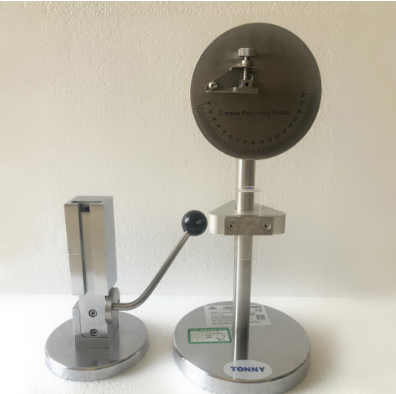
**Instrument Introduction**This instrument detects the recovery property of fabrics by applying spec
WhatsApp : +86 15601902607
Email : info@qinsun-lab.com

This instrument detects the recovery property of fabrics by applying specific test methods (BS, ISO, AATCC). It presses fabric samples under certain loading devices for a specified time, then releases them into sample clamps to allow free recovery while recording the recovery angle.
The equipment determines sample recovery performance from horizontal creases through measured wrinkle recovery angles, particularly suitable for wrinkle-prone fabrics like cellulose-based and other woven materials.
The Automatic Folding Recovery Tester measures the recovery ability of a sample after being folded for a certain period of time under a specific load. It is suitable for fabrics made from any pure or blended fibers. Materials that cannot maintain their shape under specific folding conditions, such as softer, thinner, and more easily bent materials, can have their folding resistance evaluated using this device.
AATCC 66-2014: Woven Fabrics Wrinkle Recovery: Recovery Angle Method
GB/T 3819-1997: Textiles—Determination of the recovery from creasing of a folded specimen of fabric by measuring the angle of recovery—Part 1: Method of the horizontally folded specimen
ISO 2313:2021: Part 1: Textiles—Determination of the recovery from creasing of a folded specimen of fabric by measuring the angle of recovery—Part 1: Method of the horizontally folded specimen
Part 2: Part 2: Method of the vertically folded specimen
GA 573-2009: Police Uniforms—Test Method for the Recovery of Fabrics from Creases
BS EN 22313:1992: Textile fabrics—Determination of the recovery from creasing of a horizontally folded specimen by measuring the angle of recovery
1. Ergonomic load application device for convenient specimen compression
2. Precision sample clamping mechanism ensuring horizontal positioning without bulging or slippage
| Parameter | Specification |
|---|---|
| Load weight | (500 ± 5) g × 2 units |
| Circular dial measurement range | 10°~180° |
| Sample dimensions | 40×15 mm |
| Tablet dimensions | 18×14 mm |
| Pincer jaw width | 25 mm |
| Net weight | 6 kg |
| Dimensions (L×W×H) | 17×17×36 cm |
1. Standard weights (2000g, 1000g, 500kg, 200kg)
2. 5×3 inch plastic plates (5 pieces/set)
3. Grading charts (optional)
1. Sample Preparation and Conditioning
Cut three 15cm × 28cm samples according to the test standard (e.g., AATCC 128), with the length along the warp of the fabric/the longitudinal direction of the knitted fabric. Mark the front of the sample.
Place the samples in a standard atmospheric environment (temperature 21±1℃, relative humidity 65±2%) for at least 8 hours to condition and ensure sample stability.
2. Instrument Preparation
Check the instrument calibration status and confirm that the flange, spring clamps, weights, and other components are intact.
Connect the power supply, start the equipment, and complete the system initialization via the touchscreen to enter the operating interface.
3. Sample Clamping and Parameter Setting
Lift and lock the upper flange of the instrument. Wrap the sample, front side out, along its length around the upper flange and clamp it with the spring clamp. Wrap the other end of the sample around the lower flange and secure it with the clamp as well.
Adjust the bottom of the sample to ensure it is flat and without sagging between the upper and lower flanges. Release the flange lock and gently lower the upper flange until it comes to rest.
Select the corresponding standard (e.g., AATCC 128) on the touchscreen and set the parameters: applied load (3500g weight) and holding time (20 minutes).
4. Pressure Wrinkling and Release Recovery
Start the test program. The instrument will automatically place the weight and start timing. After 20 minutes, the instrument will automatically remove the weight.
Remove the spring clamp, lift the upper flange, and gently remove the sample (avoiding twisting and wrinkling). Clamp the short side of the sample and suspend it vertically in a standard atmospheric environment.
5. Post-Recovery Rating
After suspending the specimens for 24 hours, transfer them to the rating area (maintaining standard temperature and humidity, and turning off other light sources);
Fix the specimens onto the observation board (warp direction perpendicular to the ground), place reference photographs on both sides of the specimens, and have 3 professional ratingrs independently compare and rate them.
6. Result Processing
Collect all rating results, calculate the average rating for each specimen, and output the fabric wrinkle recovery performance level.
(If using standards such as ISO 9867. only the specimen size, load/time, and other parameters need to be adjusted; the core process remains the same.)
Qinsun Instruments Co., LTD is a professional laboratory testing instrument manufacturer in China,Have been focusing on laboratory instrument R&D more than 30 years and have rich industry experience,Based on international testing standards,We are also the instrument supplier for BV SGS laboratory,We provide one-stop solutions for lab instruments,Free Training and Turn-Key Service,Products exported all over the world,Offer 36 month warranty and are a trustworthy partner.

Company Phone
+86-21-6420 0566
Working hours
Monday to Friday
Mobile phone:
13816217984
Email:
info@qinsun-lab.com