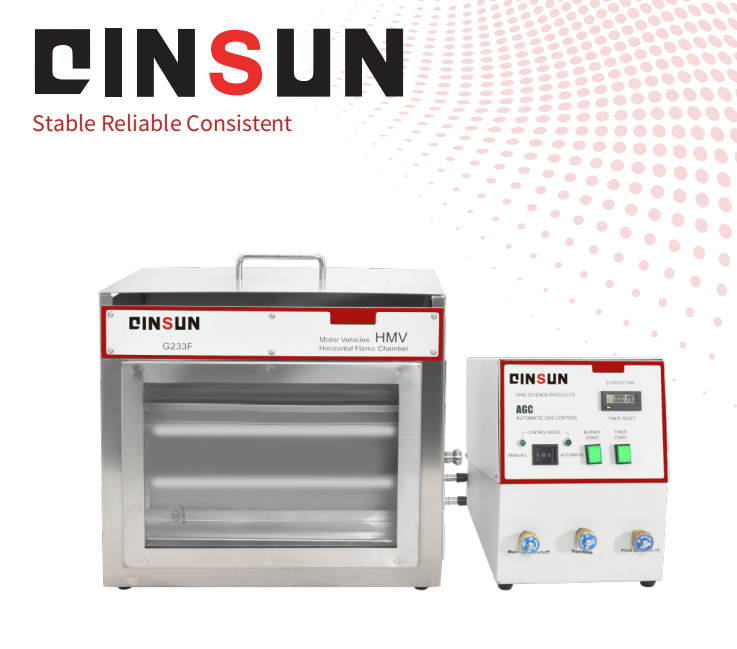
Precision Fabric Horizontal Flammability Tester for Safety Standards.
WhatsApp : +86 15601902607
Email : info@qinsun-lab.com

The horizontal flammability tester(Horizontal Flammability Test Chamber)is a device used to evaluate the combustion performance of materials. It simulates the effect of a flame on a sample in a horizontal direction, observing and recording the combustion phenomena, and measuring key parameters such as the burning rate, flame spread time, and flame retardant properties of the material. This device is widely used in fields such as textiles, plastics, and building materials, and is an important tool for product quality control and safety assessment.
Widely used in textiles, plastic products, building materials, and other fields.
Suitable for various stages including product quality control, safety assessment, and research and development testing.
DIN 75200 Combustion performance of automotive internal equipment materials
ASTM D5132 Standard Test Method for Horizontal Burning Rate of Polymeric Materials Used in Occupant Compartments of Motor Vehicles
FMVSS 302 Flame retardancy of automotive interior materials (cars, trucks, buses)
ISO 3795 Road vehicles, and tractors and machinery for agriculture and forestry - Determination of burning behaviour of interior materials
SAE J369 Flammability of Polvmericinterior Materials - Horizontal Test Method
ISO 17074 Leather - Determination of resistance to horizontal spread of flame
GB 8410 Flammability of automotive interior materials
QB/T 2729 Leather - Determination of resistance to horizontal spread of flame
Precision & Repeatability: Delivers highly repeatable experimental data to evaluate material flame-retardant performance accurately.
Broad Applicability: Tests leather, polymers, textiles, and automotive interior parts (e.g., seats, roof linings, curtains).
Safety-First Design: Electrical control and combustion chamber are separated to prevent fire hazards, ensuring stable operation.
Automated Data Capture: Precisely records ignition time and flame spread duration for objective analysis.
Compliance Assurance: Meets stringent automotive and textile industry standards, simplifying export certifications.
Research & Development Support: Provides critical data for new material development and quality control.
Dual-Chamber Structure: Isolated electrical control unit and combustion chamber enhance safety and operational stability.
Multi-Material Testing: Suitable for automotive interiors, public transport components, and industrial textiles.
Adjustable Ignition System: Angled burner (0° or 45°) with precise燃气pressure control (0-50kPa).
High-Precision Measurement: Accurately tracks flame spread distance and time (resolution: 0.1s).
User-Friendly Interface: Digital display for real-time monitoring and data storage.
Compliance-Driven: Aligns with ASTM, ISO, SAE, and DIN standards for global market access.
| Parameter | Specification |
|---|---|
| Ventilation Slot Height | 13 mm |
| Vent Hole (Bottom) | Diameter φ19 mm × Depth 10 mm |
| Observation Window Width | 330 mm |
| Sample Rack Dimensions | 255 mm × 200 mm × 170 mm (L×W×H) |
| Sample Fixture | U-Type, 355 × 25 × 10 mm (Inside Margin: 50 mm) |
| Flame Box Dimensions | 368 mm × 216 mm × 356 mm (L×W×H) |
| Burn Timer | Accuracy: ±0.1 s |
| Standard Flame Height | 38 mm |
| Collection Plate | 55 mm × 119 mm × 19 mm |
| Ignition Time | 15 s (Adjustable) |
| Overall Dimensions | 390 mm × 200 mm × 390 mm (L×W×H) |
| Support Wire | φ0.25 mm (High-Temperature Resistant Wire) |
| Spading | 25 mm |
| Weight | 31 kg |
| Power Supply | AC 220V ±10%, 50Hz |
A. Automatic gas control system (1 set);
B. DIN 75200 (Vehicle Interior Materials) testing accessories:
Includes: 1 burner, 2 nozzles;
C. SAE J369 (Polymer Interior Materials) testing accessories:
Includes: 1 burner, 2 nozzles;
D. ASTM D5132 (Polymeric Materials in Motor Vehicle Interiors) testing accessories:
Includes: 1 burner, 2 nozzles;
E. Other testing standards: 1 burner and 1 nozzle each.
1. Take out the pre-treated sample. Place the sample with a napped or tufted surface flat on a level surface. Use a metal comb conforming to the requirements of 4.2.5 to comb the napped surface twice in the opposite direction of the pile.
2. Light the gas lamp with the air inlet closed. Adjust the flame using the flame height indicator plate so that the flame height is 38 mm. Before starting the test, the flame should burn steadily in this state for at least 1 minute, and then be extinguished.
3. Mount the sample in the sample holder with the exposed surface facing downwards. Install the sample so that both sides and one end are clamped by the U-shaped holder, and the free end is aligned with the opening of the U-shaped holder. Only when the sample width is insufficient for the U-shaped holder to clamp the sample, or when the free end of the sample is soft and easily bent, causing unstable combustion, should the sample be placed on a sample holder with heat-resistant metal wires for the combustion test.
4. Push the sample holder into the combustion chamber. Place the sample in the center of the combustion chamber in a horizontal position. Light the gas lamp with the air inlet closed, and adjust the flame height to 38 mm. Ignite the free end of the sample in the flame for 15 seconds, then extinguish the flame (close the gas lamp valve).
5. The flame burns forward from the free end of the sample. Start timing the moment the base of the propagating flame passes the first mark. Observe the flame propagation on the faster burning side, and the timing should be based on the faster burning side.
6. Stop timing when the flame reaches the second mark or when the flame is extinguished before reaching the second mark. The timing should also be based on the faster burning side. If the flame is extinguished before reaching the second mark, measure the burning distance from the mark to the point where the flame is extinguished. The burning distance refers to the length of the burned portion on the surface or inside the sample.
7. If the non-exposed surface of the sample has been cut, the timing should be based on the flame propagation speed of the exposed surface. 8. The requirements for burning rate do not apply to surfaces formed by cutting the test specimen.
9. If the specimen burns slowly for an extended period after the start of timing, the test may be stopped after 20 minutes, and the burning time and burning distance should be recorded.
Qinsun Instruments Co., LTD is a professional laboratory testing instrument manufacturer in China,Have been focusing on laboratory instrument R&D more than 30 years and have rich industry experience,Based on international testing standards,We are also the instrument supplier for BV SGS laboratory,We provide one-stop solutions for lab instruments,Free Training and Turn-Key Service,Products exported all over the world,Offer 36 month warranty and are a trustworthy partner.

Company Phone
+86-21-6420 0566
Working hours
Monday to Friday
Mobile phone:
13816217984
Email:
info@qinsun-lab.com