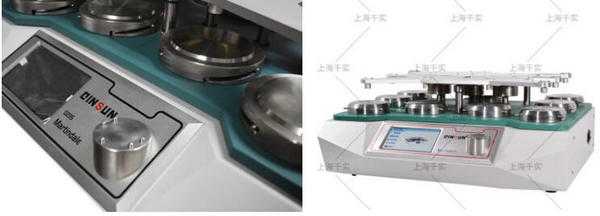
Martindale Abrasion And Pilling TesterMartindale Abrasion & Pilling Tester. To determine the abrasio
WhatsApp : +86 15601902607
Email : info@qinsun-lab.com

The instrument is professionally designed to determine the abrasion and pilling resistance of all kinds of textile structures.
Samples are rubbed against known abradents at low pressures and in continuously changing directions and the amount of abrasion or pilling is compared against standard parameters.
Provided with Touch Screen Controller and unique programming device which includes preprogammable batch and totaliser counters, individual station counters, 4 selectable test speeds with liquid crystal display.
The Martindale abrasion tester is widely used in various industries, including textiles, leather, and synthetic materials. Through testing, it can evaluate the abrasion resistance of various fabrics, providing important data for product design and quality control. This instrument is also suitable for evaluating the abrasion resistance of materials under other conditions, such as resistance to water and oil.
GB/T 13775-92: Test Method for Abrasion Resistance of Cotton, Linen, and Silk Woven Fabrics
ASTM D4966:Textile Fabrics Abrasion Resistance (Martindale Tester Method)
ISO 12947-1:1998 Part 1: Martindale abrasion testing apparatus
ISO 12947-2:2016 Part 2: Determination of specimen breakdown
The Martindale abrasion tester simulates the wear and tear on a material's surface during actual use, subjecting the sample to continuous, quantitative abrasion to evaluate its wear resistance. It primarily consists of a parallel-moving test platform and a rotating disc with an abrasion head. The sample to be tested and a standard abrasive material (such as silk or cotton fabric) are fixed to the test platform and the rotating disc, respectively. When the rotating disc begins to rotate, the abrasion head abrades the sample, simulating the wear and tear the sample would experience in real-world use.
1. Test bench: Used to fix the sample to be tested and bring it into contact with the wear head on the rotating disc for friction testing.
2. Rotating disc: Equipped with a wear head, used to perform wear testing on the sample.
3. Clamping device: Used to fix the sample, ensuring that the sample does not move or deform during the test.
4. Counter: Records the number of friction cycles during the test, ensuring that the number of friction cycles is the same for each test, thus improving the reliability of the test results.
5. Control system: Used to set test parameters (such as friction speed, pressure, number of cycles, etc.) and monitor the testing process.
| Technical Indicators | Specifications & Descriptions |
|---|---|
| Number of Workstations | Usually 4 or 8 workstations, allowing simultaneous testing of multiple samples to improve test efficiency. |
| Count Display | Capable of showing preset count and cumulative count, facilitating users to record and analyze test data. |
| Stroke | Typically 24±0.5mm or 60.5±0.5mm, referring to the moving distance of the abrasion head during the test. |
| Mass of Pressurizing Components | Including the mass of holders, sample weights, stainless steel discs, etc., used to apply a certain pressure to the samples. |
| Effective Friction Diameter of Abrasion Block | Refers to the diameter of the abrasion head; different specifications are usually available for selection. |
| Relative Movement Speed Between Holder and Abrasion Table | Refers to the relative movement speed between the abrasion head and the sample; a certain adjustable range is usually available. |
1. Sample Preparation
Prepare samples of appropriate size according to testing standards or customer requirements, ensuring that the sample surface is flat and free of defects.
2. Setting Test Parameters
Set the test parameters of the Martindale abrasion tester according to testing standards or customer requirements, such as friction speed, pressure, and number of cycles.
3. Conducting the Abrasion Test
Fix the sample onto the holder, start the instrument, and allow the abrasion head on the rotating disc to rub against the sample. During the test, observe the wear of the sample and record the test data.
4. Evaluating Test Results
Evaluate the abrasion resistance of the sample according to testing standards or customer requirements. Abrasion resistance is usually assessed using indicators such as the number of abrasion cycles or the degree of wear.
Qinsun Instruments Co., LTD is a professional laboratory testing instrument manufacturer in China,Have been focusing on laboratory instrument R&D more than 30 years and have rich industry experience,Based on international testing standards,We are also the instrument supplier for BV SGS laboratory,We provide one-stop solutions for lab instruments,Free Training and Turn-Key Service,Products exported all over the world,Offer 36 month warranty and are a trustworthy partner.

Company Phone
+86-21-6420 0566
Working hours
Monday to Friday
Mobile phone:
13816217984
Email:
info@qinsun-lab.com